Building Software That Solves Real Problems
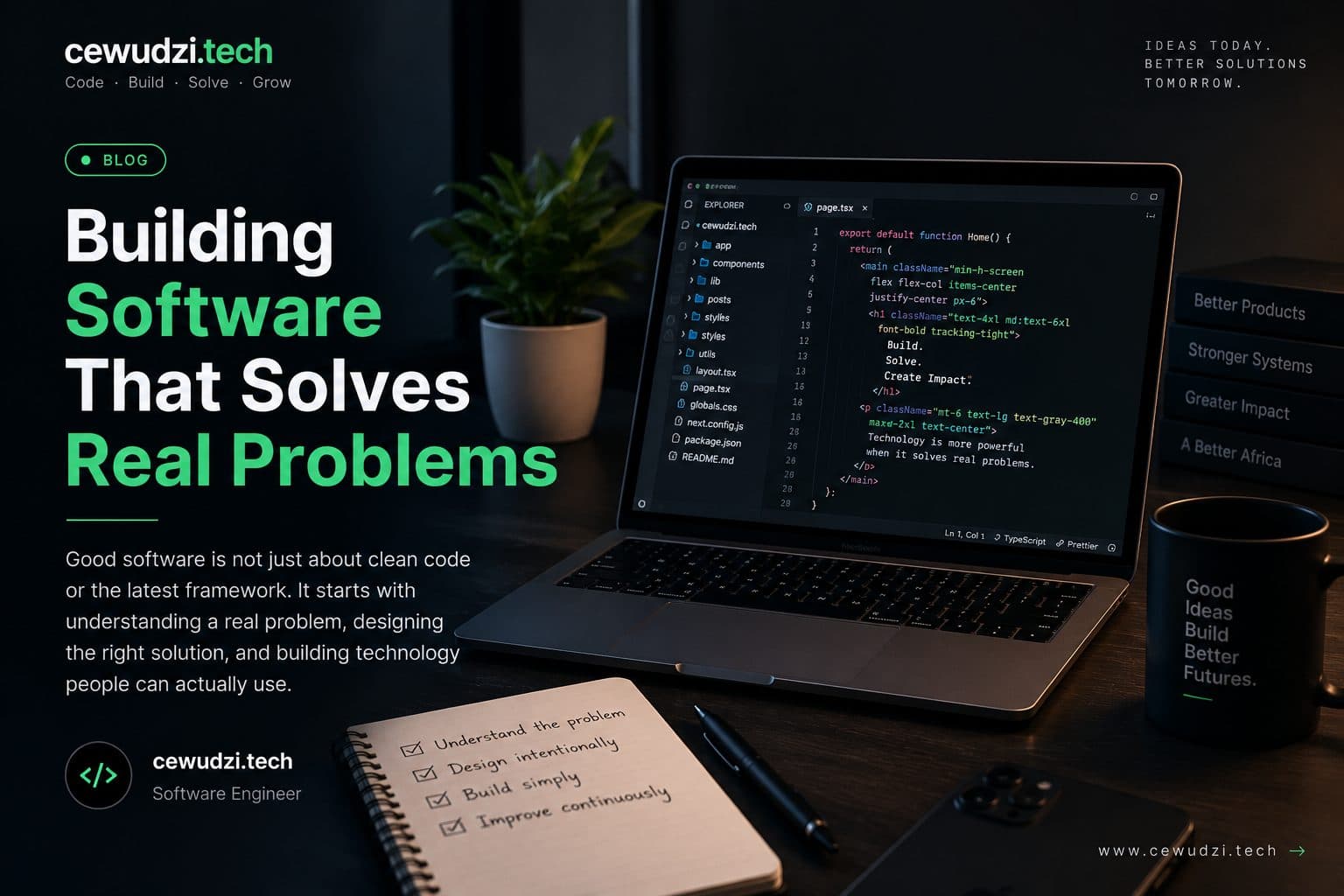
Building Software That Solves Real Problems
There is a big difference between building software and building useful software.
As developers, it is easy to get excited about frameworks, programming languages, databases, cloud platforms, and the newest tools in the industry.
But users rarely care whether an application was built with React, Next.js, NestJS, PostgreSQL, or another technology.
They care about one thing:
Does it solve my problem?
That question has gradually shaped the way I think about software development.
Start With the Problem
Before writing code, I believe one of the most important questions to ask is:
What problem are we actually trying to solve?
A technically impressive application can still fail if nobody really needs it.
Understanding the problem means understanding the people experiencing it.
That involves asking questions such as:
- Who is the user?
- What are they currently struggling with?
- How are they solving the problem today?
- What is frustrating about the current solution?
- What would make their experience significantly better?
The answers to these questions should influence the technology we build.
Technology Is a Tool, Not the Goal
I enjoy working with modern technologies and exploring better ways of building applications.
However, choosing technology should always come after understanding the requirements.
For example, a project might use:
- Next.js for a fast and responsive frontend
- NestJS for a structured backend
- PostgreSQL for reliable data storage
- Redis for caching
- Cloud storage for files and media
- Vercel or other cloud platforms for deployment
These technologies can be powerful, but they are only valuable when they contribute to solving the user's problem.
The best stack is not necessarily the most complicated one.
It is the one that fits the product.
User Experience Matters
Another lesson I continue to learn is that functionality alone is not enough.
An application can technically work while still being frustrating to use.
Good software should feel simple.
Users should not have to understand the complexity happening behind the scenes.
Things like:
- clear navigation
- fast loading times
- responsive interfaces
- useful error messages
- accessibility
- mobile compatibility
- reliable authentication
can make a huge difference.
Sometimes improving one small interaction creates more value than adding ten new features.
Build the Smallest Useful Version First
It can be tempting to build every possible feature before launching a product.
That usually creates unnecessary complexity.
A better approach is to identify the core value of the product and build the smallest version capable of delivering that value.
This is often called an MVP — Minimum Viable Product.
An MVP allows you to:
- Validate the idea.
- Get feedback from real users.
- Discover incorrect assumptions early.
- Improve the product based on actual usage.
- Avoid spending months building features nobody needs.
Software becomes better through iteration.
Security Should Be Part of the Design
Security should also not be treated as something to add after development is complete.
Authentication, authorization, data validation, database permissions, secure API design, backups, logging, and infrastructure security should all be considered during development.
A system is only useful if users can trust it.
This becomes even more important when applications handle personal information, payments, business data, or private documents.
Keep Learning
Software engineering changes constantly.
Frameworks evolve.
New tools appear.
Best practices improve.
Artificial intelligence is changing how developers write, test, debug, and understand software.
Because of this, being a developer means continuously learning.
But I think the most valuable skill is not memorizing every technology.
It is developing the ability to:
understand a problem, learn what is required, and build an effective solution.
Final Thoughts
I want the projects I build to go beyond simply demonstrating that I can write code.
I want them to solve problems.
Whether I am building a web application, mobile application, internal business system, e-commerce platform, or experimenting with a new idea, that remains the goal.
Understand the problem.
Design intentionally.
Build simply.
Improve continuously.
That is the kind of software engineering I want to practice.